Why Modern Electronic Air Suspension Repairs Depend on Special Functions
Electronic air suspension repairs may require scan-tool functions to disable automatic height control, manage system pressure, operate components and verify the repair. Depending on the vehicle and procedure, these functions may be required before, during and after component replacement.
What Is Electronic Air Suspension?
Electronic air suspension uses pressurized air springs, electronic controls and sensor information to manage vehicle height. System design and component location vary, so technicians should always follow the applicable vehicle-specific service information.
Working together, these components allow the system to manage air pressure and vehicle height. Depending on the vehicle design, electronic air suspension may support load levelling, selectable ride heights or automatic height changes under defined operating conditions.
Why Are Air Suspension Repairs Different?
Electronic air suspension has evolved beyond simple ride comfort. Modern systems can adjust vehicle height for:
- Highway driving
- Off-road conditions
- Vehicle loading
- Entry and exit assistance
- Handling and stability improvements
Conventional suspension work is often focused primarily on mechanical inspection, removal and replacement. Electronic air suspension can add another layer to the repair; before replacing certain components, a technician may need to:
- Disable automatic height control
- Place the control module in the appropriate service state
- Deflate an air spring or transfer air to a reservoir
- Check residual system pressure
- Review ride-height or pressure data
After component replacement, additional functions may be needed to:
- Refill an air spring
- Restore or adjust system air pressure
- Re-enable suspension control
- Perform an applicable calibration or calculation
- Verify system operation
The functions required depend on the vehicle, system and repair being performed. Technicians should follow the applicable service information and all instructions displayed by the diagnostic platform.
Why Component Replacement May Not Complete the Repair
A potentially costly misconception is that a suspension repair ends when the replacement component has been installed.
The mechanical repair may be completed correctly, but the suspension control system may still require an after-repair function. Depending on the application, this could include a pressure-management routine, ride-height calibration, air-mass calculation, sensor calibration or system verification.
If a required function is not completed, the result may include:
- Incorrect vehicle height
- Warning indicators
- Suspension fault codes
- Improper suspension operation
- A repeat customer visit
How Do Ride-Height Sensors Support the System?
Ride-height sensors provide suspension-position information to the vehicle’s control system. This information helps the system determine the vehicle’s position relative to the body and manage the suspension accordingly.
When a sensor or related suspension component is removed, replaced or adjusted, the system may require a calibration or relearn. The specific requirement varies by vehicle and procedure.
A ride-height calibration should not be treated as a universal step after every suspension repair. Technicians should confirm whether it is required by consulting the applicable service information and the vehicle-specific functions available on their Snap-on diagnostic platform.
A Real-World Suspension Repair Scenario

2019 Jeep® Grand Cherokee
The vehicle-specific repair information shown below identifies the scan-tool functions required before removing the upper control arm on a 2019 Jeep® Grand Cherokee equipped with the SER air suspension system.
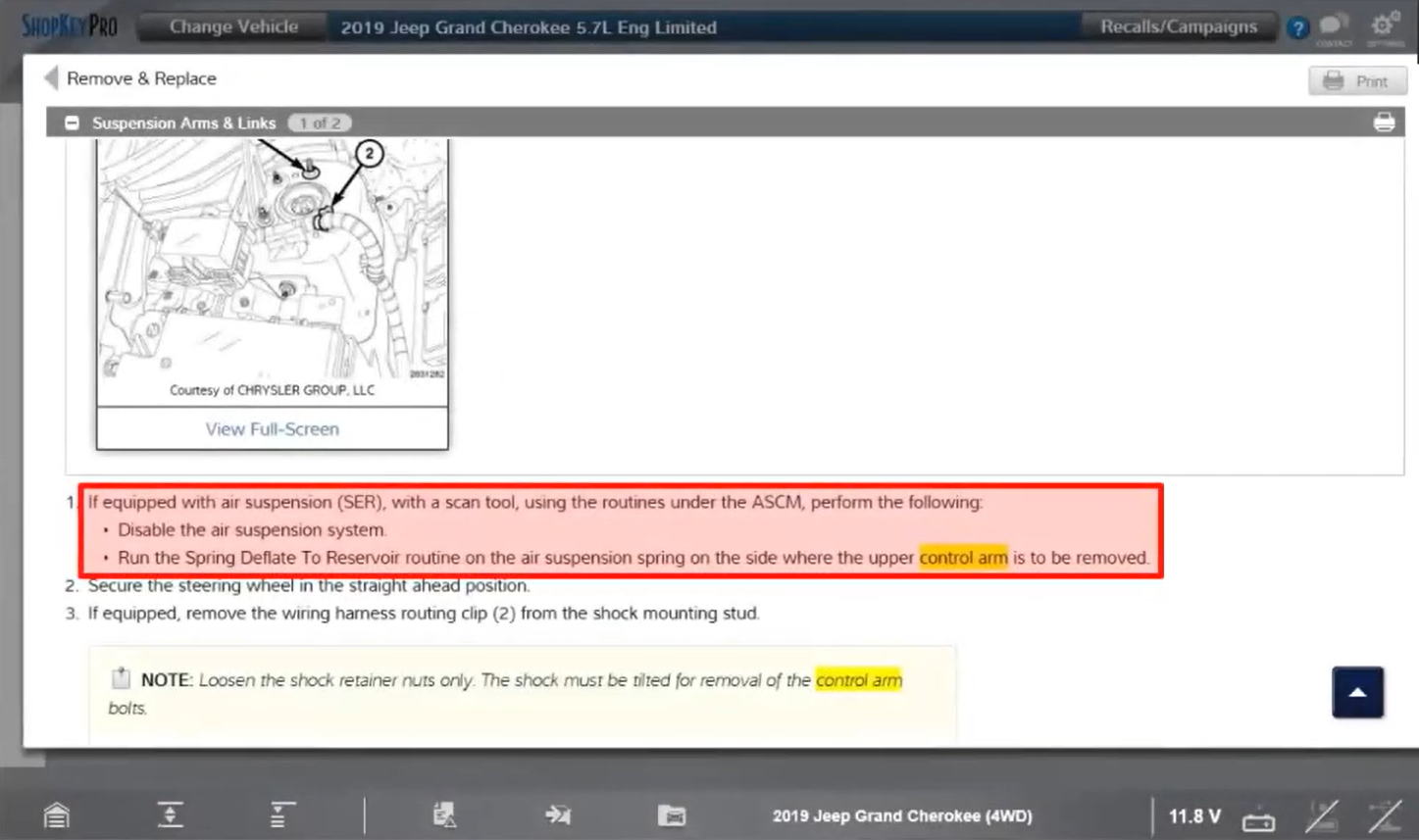
ShopKey® Repair Information identifies the required air-suspension functions before upper control-arm removal. ShopKey Repair is available as an optional subscription on compatible Snap-on® diagnostic platforms.
Before removing the control arm, the technician uses a scan tool to disable the air suspension system. This disables level control for the current ignition cycle and places the Air Suspension Control Module, or ASCM, in Plant Mode.
Next, the technician runs the Spring Deflate Reservoir routine on the side being repaired. This reduces the air spring to a predefined pressure set point, although some residual pressure remains. The Component Air Mass/Pressure/Ride-Height Readings routine can then be used to check the residual pressure after venting.
Running the Spring Deflate Reservoir routine may set DTC C2212-00. If this occurs, the ASCM Exit Plant Mode functional test must be performed to clear the code.
After the Control-Arm Replacement
Once the control arm has been replaced, the after-repair sequence includes:
- Run Fill Spring from Reservoir/Complete Fill for the affected air spring.
- Run the Air Mass Calculation routine.
- If required, use the appropriate ASCM routines to add air to the system or deflate it to atmosphere.
- Repeat the Air Mass Calculation until the system returns an Air Mass OK result.
- Enable the air suspension system.
- Perform the ASCM Verification Test.
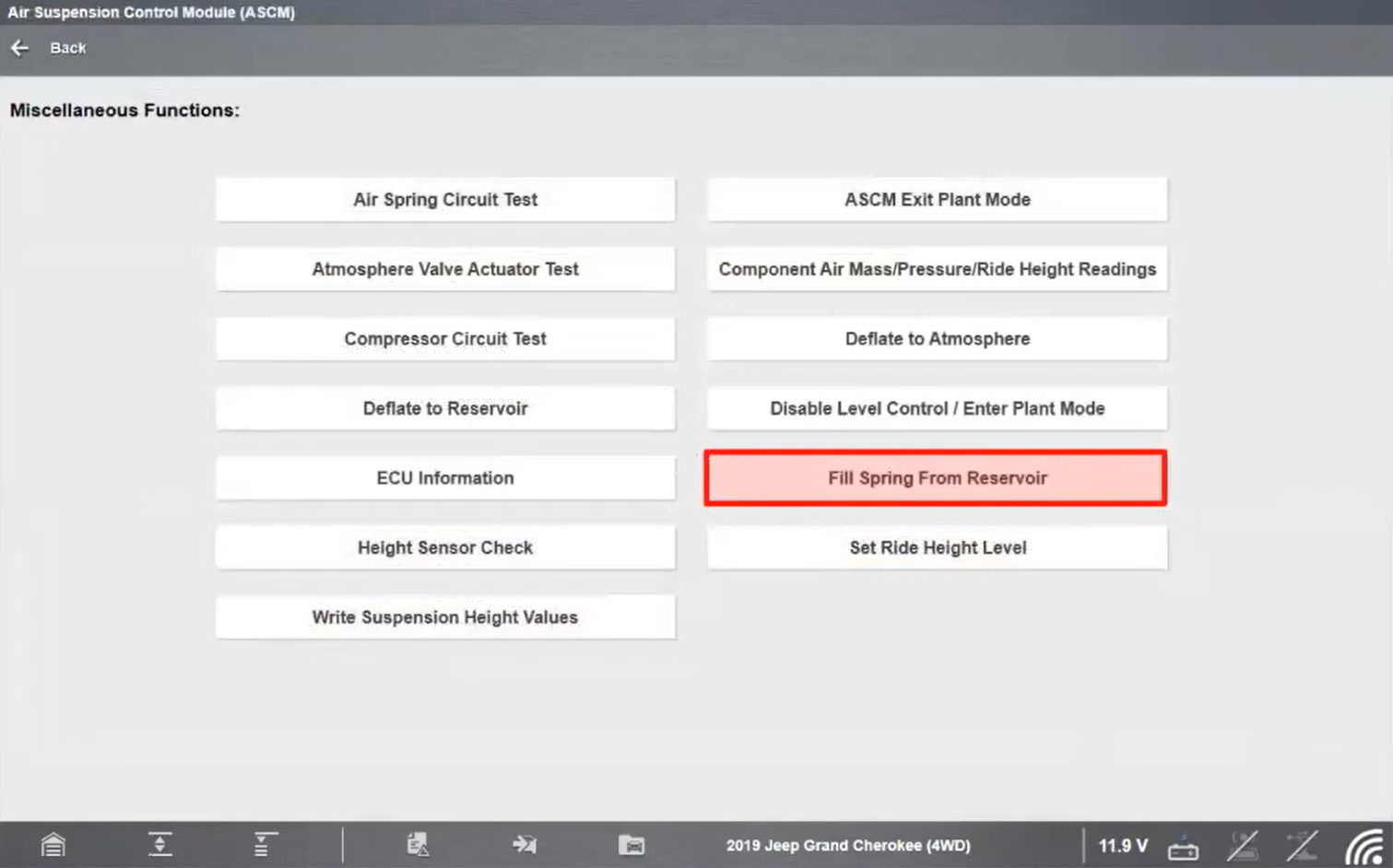
This scenario shows why replacing the mechanical component may not complete the repair. Scan-tool functions are used to prepare the suspension system for component removal, manage air pressure and complete the required after-repair checks.
Important: This example is intended to illustrate the role of vehicle-specific service functions. It is not a substitute for the complete repair procedure. Always follow the applicable service information, safety precautions and on-tool instructions.
Complete Air Suspension Repairs with Snap-on® Diagnostic Software
These functions are available for supported vehicles on SOLUS®, APOLLO™, TRITON™ and ZEUS® Series diagnostic platforms with the latest Snap-on® software release installed. Technicians can access relevant codes, live data, functional tests and special functions using the platform that best suits their shop. Compatible platforms also provide access to SureTrack®, verified Real Fixes and real-world repair information. Coverage and functionality vary by vehicle, model year, system, platform and software version. For the latest software functionality and coverage, visit the Snap-on Software Website.
Recommended Diagnostic Tool for Electronic Air Suspension Repair
Snap-on® SOLUS+™
Electronic air suspension repairs increasingly rely on calibration and service procedures rather than component replacement alone.
SOLUS+™ provides access to the essential service functions needed to diagnose, repair and recalibrate modern electronic suspension systems.
USAGE
Every Day
EXPERIENCE LEVEL
Established
TECHNICIAN ROLE
General Repair Technician, Service Writer
ADDITIONAL FEATURES
Service Resets, Relearns, Suspension Service, Functional Tests, Component Replacement, Diagnostic Procedures
I'm Interested
Related Resources for Electronic Air Suspension Repair
FAQs
1) What is electronic air suspension?
Electronic air suspension uses pressurized air springs, electronic controls and sensor information to manage vehicle height on equipped vehicles.
2) Why might air suspension work require a scan tool?
A scan tool may be needed to disable automatic height control, manage system pressure, operate components, perform an applicable calibration or complete an after-repair verification routine.
3) Does every air suspension repair require calibration?
No. Requirements depend on the vehicle, system, component and procedure. Always consult the applicable service information.
4) Can an air suspension repair be completed without a scan tool?
Some inspections and repairs may not require special functions, but many electronic air suspension procedures require scan-tool access for system control, pressure management, calibration or verification.
*This article is intended for informational purposes only and provides general technical insight. It is not intended to serve as step-by-step repair, service or diagnostic instruction. Always follow manufacturer-approved procedures and safety guidelines. Consult the relevant vehicle manufacturer’s service information when carrying out diagnosis, maintenance, servicing or repairs. Snap-on® diagnostic coverage and functionality may vary by vehicle, model year, transmission, software version and platform. References to vehicle manufacturers, models and trademarks are for identification and compatibility purposes only and do not imply affiliation with or endorsement by the respective trademark owners. Some illustrations in this article are AI-generated and are provided for general explanatory purposes only; they are not manufacturer schematics and should not be relied on for component identification or repair instructions.