How Modern ABS Brake Systems Work
Modern brake systems do far more than simply stop a vehicle. Today's braking systems combine wheel speed sensors, control modules, hydraulic units and vehicle dynamics systems to improve safety and vehicle control.
Today's braking systems support much more than anti-lock braking. Functions such as traction control, stability control and automatic emergency braking all rely on information managed through the ABS system.
As braking technology has evolved, so has the repair process. In many cases, replacing a component is only part of the job, with additional service procedures required following repair. One example is the ABS Brake Bleed Procedure available on 2021+ Ford® F‑250 vehicles, which serves as the case study for this article.
How Wheel Speed Sensors Support ABS Operation
Brake system operation begins with accurate wheel speed information. Most modern vehicles use active wheel speed sensors, typically integrated into the wheel bearing assembly, to monitor wheel rotation and provide highly accurate speed information even at very low speeds.
Earlier systems commonly used passive inductive sensors, which generated an AC signal as a reluctor ring rotated past the sensor. While these designs are still encountered, active sensors have become increasingly common due to their improved low-speed accuracy and ability to support ABS, traction control and stability control systems.
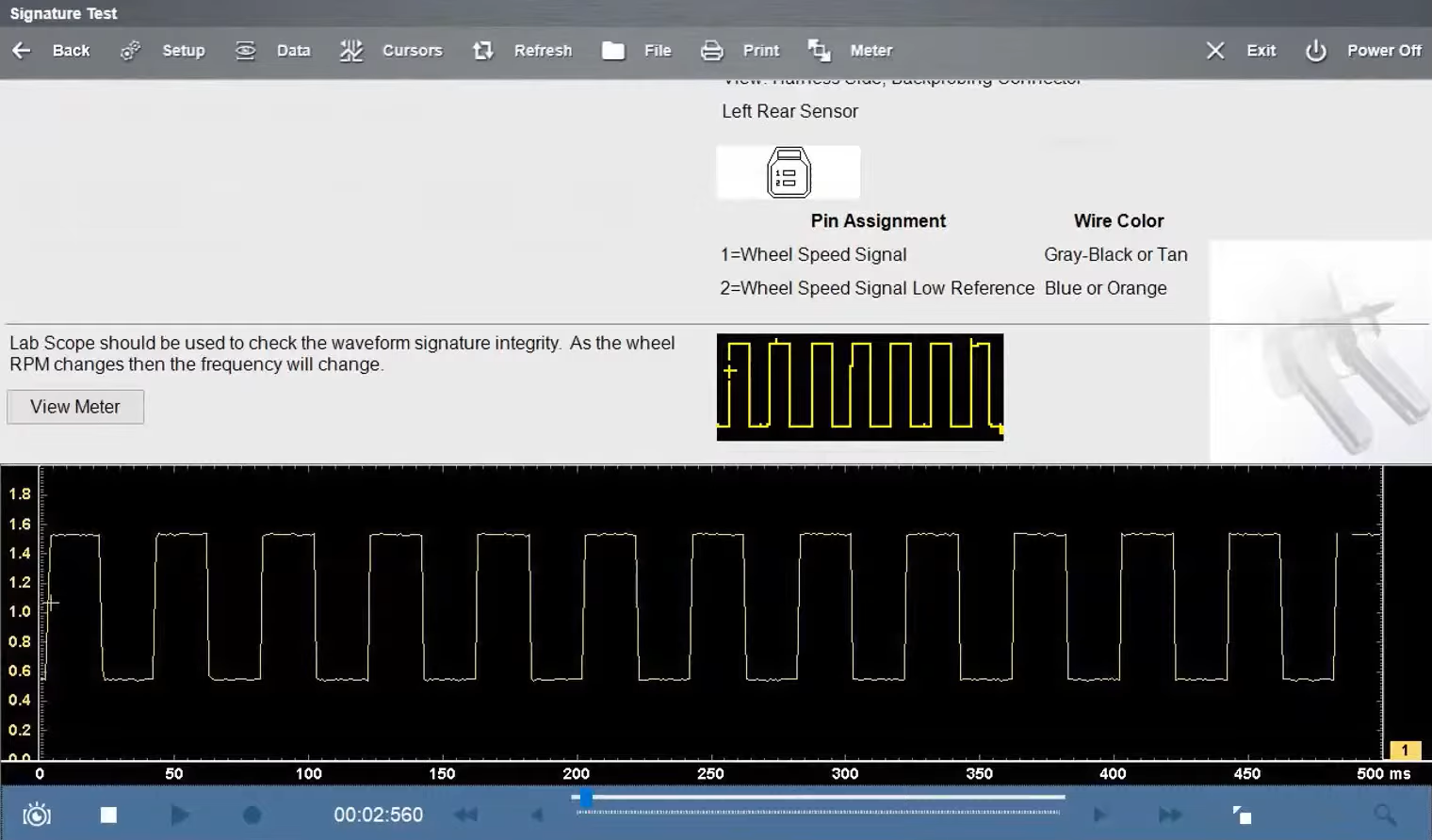
Unlike inductive sensors, active wheel speed sensors maintain a consistent signal amplitude and use changes in frequency to indicate wheel speed.
How to Diagnose ABS Wheel Speed Sensor Faults
Diagnosing wheel speed sensor faults often involves more than checking for diagnostic trouble codes. Signal quality, sensor installation, air gaps, damaged encoder rings and contamination can all influence operation. Modern diagnostic strategies increasingly rely on waveform analysis and live data.
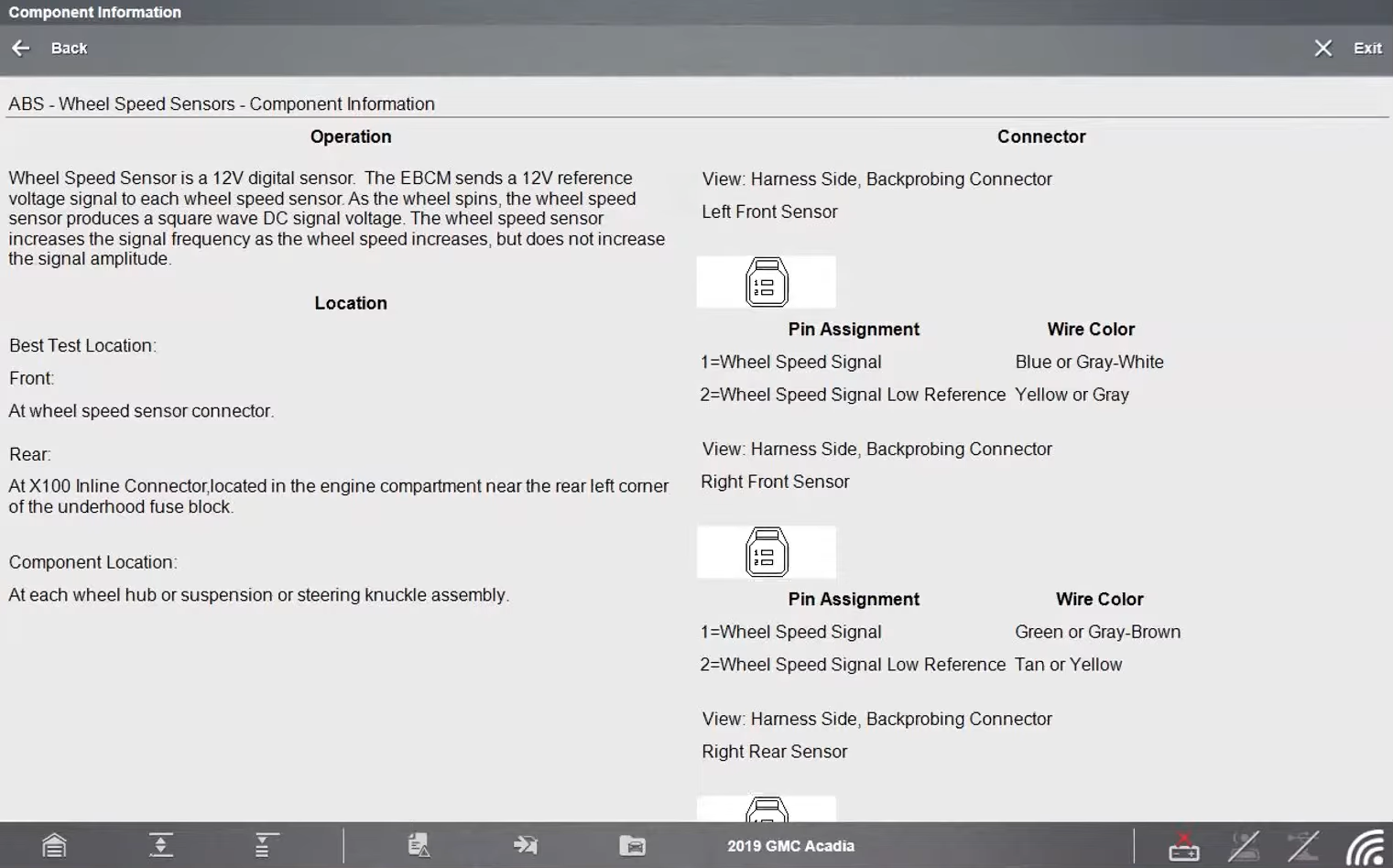
Snap-on® Guided Component Tests provide vehicle-specific testing procedures, known-good waveforms and guided instructions designed to help technicians verify sensor operation confidently. Rather than relying on assumptions, technicians can compare vehicle signals against known-good examples and verify system performance before replacing components. See example case study image below, which features a 2019 GMC Acadia.
The image below illustrates a known-good waveform for a signature test on a wheel speed sensor.
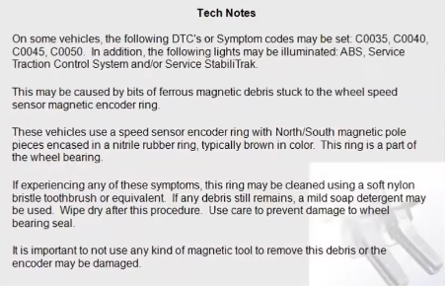
Additionally, Fast-Track Intelligent Diagnostics provides technician notes based on real-world repair experiences. For example, on some GMC Acadia vehicles, DTCs such as C0035, C0040, C0045 and C0050 may be accompanied by ABS, Service Traction Control or StabiliTrak warnings, with known fixes and diagnostic guidance provided within the software.
*Guided Component Tests available on ZEUS® and TRITON™ platforms with current software.
How ABS Supports Traction Control, Stability Control
Modern braking systems support far more than ABS alone. Functions such as electronic stability control, traction control and automatic emergency braking rely on inputs from wheel speed sensors and other vehicle dynamics systems to help maintain traction and stability.
When Is an ABS Brake Bleed Procedure Required?
One of the biggest changes in vehicle repair is the growing number of service procedures required after mechanical work has been completed. Electronic parking brakes, steering angle resets, brake pedal relearns and ABS brake bleeding procedures have all become part of the repair process. The repair itself frequently creates the need for the procedure.
This is particularly true of hydraulic brake system repairs. When brake hydraulics are opened during repairs, air can enter the system. While conventional bleeding procedures can often remove air from the brake lines and calipers, air may remain trapped within the ABS hydraulic control unit. That is where the ABS Brake Bleed Procedure becomes necessary.
Electronic Parking Brake Service Procedures
Brake service procedures are not limited to ABS bleeding. Many modern vehicles fitted with electronic parking brakes require the parking brake system to be placed into a service or maintenance mode before brake pads can be replaced.
Depending on the vehicle, the system may require the parking brake or caliper mechanism to be electronically moved into a service position. Manufacturer-specific instructions are increasingly important, as some vehicles include additional conditions that can affect the procedure.
For example, certain vehicles may automatically reapply the electronic parking brake if specific conditions occur during maintenance mode. Snap-on® diagnostic software includes guided service functions and procedure-specific information to help technicians avoid common mistakes and complete brake system maintenance correctly.
The Assumption That Creates Comebacks
One of the most common assumptions following brake repairs is that once the hydraulic system has been conventionally bled, the repair is complete. Modern braking systems don't always work that way.
Following repairs involving brake calipers, hydraulic lines, master cylinders or ABS-related components, trapped air can remain inside portions of the hydraulic control unit. A technician may believe the system has been properly serviced, only to experience excessive pedal travel, inconsistent brake feel or customer complaints after the vehicle leaves the shop.
The key takeaway is simple: Replacing the component may fix the fault. Completing the ABS Brake Bleed Procedure finishes the repair.
Ford® F‑250 Case Study
Completing the Repair with the ABS Brake Bleed Procedure
On the 2021+ Ford® F‑250, certain brake system repairs may require the ABS Brake Bleed Procedure to remove trapped air from the hydraulic system following service.
Following repairs such as brake caliper replacement, technicians can access the procedure directly through their Snap-on® diagnostic platform.
Some vehicles, including Nissan®, FIAT® Chrysler® Automobiles (FCA), Volkswagen® Audi® Group (VAG), Volvo®, Mercedes-Benz®, Ford® and Hyundai® / Kia®, require Snap-on® Security Link™ to access secure vehicle systems. For more information on Snap-on® Security Link™ and the full capabilities click here.
The Ford F-250 ABS Brake Bleed Procedure is available on MT2600, SOLUS+™, APOLLO™, TRITON™ and ZEUS+® Series platforms with current software. The function can be accessed through the Common Selections menu or via the Service Resets & Relearns menu, where procedures are grouped together for quick and consistent access. This makes it easy for technicians to locate and perform the required procedure following brake system servicing or repairs.
Accessing the ABS Brake Bleed Procedure
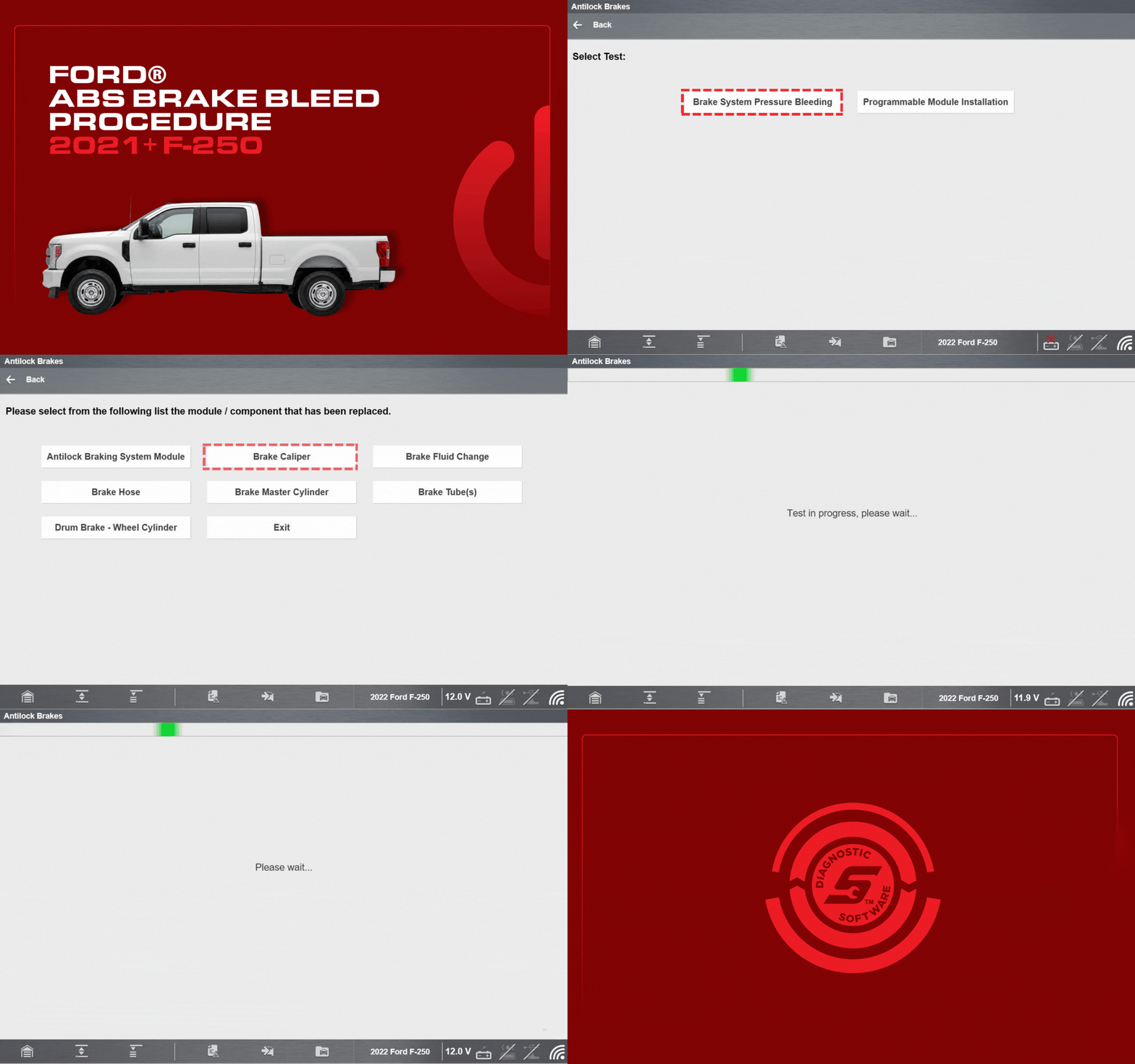
*Shown on a Snap-on® TRITON™
From the System Menu:
- Select Antilock Brakes from the Common Selections menu.
- Select Functional Tests.
- Select Special Functions.
- Select Brake System Pressure Bleeding.
Before beginning, ensure the ignition is switched on, the engine is not running, the battery is fully charged or connected to a support unit, the correct brake fluid is being used, and all repairs have been completed.
You are then prompted to identify which component was replaced. In this example, a brake caliper was selected, followed by the appropriate wheel location. The software then guides the technician through the pressure bleeding process using on-screen prompts.
Why the ABS Bleed Procedure Matters
The procedure is designed to help remove trapped air from the hydraulic system following repair. During the process, the hydraulic control unit is commanded to operate while the brake bleeding procedure is performed. During the procedure:
- Brake fluid level must be maintained above the minimum level.
- A pressure bleeding system must be connected.
- The hydraulic control unit will operate during the bleeding sequence.
- The brake pedal should not be pressed while the hydraulic control unit is running.
This helps remove air that may remain trapped within the ABS hydraulic control unit following repair work.
Preventing Comebacks After ABS Brake Bleeding
One common mistake is assuming conventional bleeding alone is sufficient following every brake repair. However, modern ABS systems frequently require dedicated service procedures to fully restore hydraulic performance.
By following the guided ABS Brake Bleed Procedure, technicians can confidently complete the repair, verify brake system operation and reduce the risk of customer comebacks caused by trapped air within the system.
Recommended Diagnostic Tool for ABS Brake Servicing
USAGE
3-5 Times a Week
EXPERIENCE LEVEL
Advanced
TECHNICIAN ROLE
Diagnostic Specialist, Shop Manager
ADDITIONAL FEATURES
Access to Technical Service Bulletins (TSBs), Lab Scope Capabilities, Step-by-Step Guided Tests, Suggested Expert Information from Other Techs, Advanced Graphing Features, Known Good Waveforms, Filtered Data, In-Tool Learning
I'm Interested
Today's Repairs Go Beyond Parts Replacement
The ABS Brake Bleed Procedure on the 2021+ Ford® F‑250 is one example of how modern repairs rely on diagnostic software as well as mechanical expertise.
Having access to these procedures directly through a Snap-on® diagnostic platform helps technicians work more efficiently, reduce customer comebacks and return vehicles to service with confidence.
Related ABS and Brake Diagnosis Resources
FAQs
1) What is an ABS Brake Bleed Procedure?
An ABS Brake Bleed Procedure is a guided service function used to remove trapped air from the brake hydraulic system, including air that may remain within the ABS hydraulic control unit following brake system repairs.
2) When should the Ford® F-250 ABS Brake Bleed Procedure be performed?
The ABS Brake Bleed Procedure should be considered following brake system repairs where air may enter the hydraulic circuit, including brake caliper replacement, hydraulic line repairs and other brake system service operations.
3) Why is the ABS Brake Bleed Procedure important?
Air trapped within the brake hydraulic system can affect brake pedal feel, braking performance and overall brake operation. Performing the ABS Brake Bleed Procedure helps remove trapped air and restore proper hydraulic system performance following repair.
4) Can conventional brake bleeding replace the ABS Brake Bleed Procedure?
Not always. Modern ABS systems may retain air within the hydraulic control unit. The ABS Brake Bleed Procedure helps cycle components within the system to remove trapped air that conventional bleeding methods may not fully eliminate.
5) What types of brake services or repairs commonly require an ABS Brake Bleed Procedure?
ABS Brake Bleed Procedures are commonly required following repairs that open the hydraulic brake system, including:
- Brake caliper replacement
- Brake line replacement
- Master cylinder replacement
- ABS hydraulic unit repairs
- Other brake system repairs where air may enter the hydraulic circuit
In many cases, the repair itself creates the need for the procedure.
6) What components are involved in a modern ABS system?
Modern ABS systems commonly include:
- Wheel speed sensors
- ABS control module
- Hydraulic control unit (HCU)
- Hydraulic pump
- Solenoid valves
- Brake master cylinder
- Brake calipers and hydraulic brake circuits
Together, these components help regulate brake pressure and support vehicle safety systems.
7) How are wheel speed sensors used in modern ABS systems?
Wheel speed sensors provide the ABS module with information about individual wheel speed. This information is used to detect wheel slip and help control braking force during ABS, traction control and stability control operation.
8) Which Snap-on® diagnostic platforms support the Ford® F-250 ABS Brake Bleed Procedure?
The Ford® F-250 ABS Brake Bleed Procedure is available on supported Snap-on® diagnostic platforms running current software, including MT2600™, SOLUS®, APOLLO™, TRITON™ and ZEUS® Series products.
9) What Snap-on® features help with brake system diagnostics and repair verification?
Supported Snap-on® diagnostic platforms provide access to:
- Complete Code Scan
- Diagnostic Health Scan
- Guided Component Tests
- Fast-Track® Intelligent Diagnostics
- Service Resets & Relearns
- Snap-on® Cloud reporting
These features help technicians diagnose system concerns, document repairs and verify successful repair completion.
10) What is the one key takeaway technicians should remember?
The ABS Brake Bleed Procedure is often the final step required to complete the repair. Following certain brake system repairs, failing to perform the procedure can leave air trapped in the hydraulic system and affect brake operation.
*This article is intended for informational purposes only and is designed to provide general technical insight. It is not intended to serve as step-by-step repair, service or diagnostic instruction. Always follow manufacturer-approved procedures and safety guidelines when carrying out vehicle diagnostics, brake system service or repairs.
Technicians should always consult the relevant vehicle manufacturer's service information when carrying out diagnosis, maintenance, servicing or repairs. Ford is a registered trademark of Ford Motor Company. Any reference to vehicle manufacturers, models or trademarks is for identification and compatibility purposes only and does not imply any affiliation with or endorsement by Ford. Snap-on® diagnostic coverage and functionality may vary by vehicle, model year, software version and platform.