Advanced Driver Assistance Systems (ADAS) continues to play an increasingly important role in modern vehicle safety. Features such as Adaptive Cruise Control (ACC), Forward Collision Warning and Smart Brake Support all depend on accurate information from the vehicle's front RADAR sensor. When repairs affect the location or alignment of that RADAR, recalibration becomes a critical step in restoring proper system operation.
With the latest Snap-on® software release, technicians can now access the Front RADAR Dynamic Aiming Special Function on 2024 and newer Mazda CX-50 and CX-90 vehicles. This new coverage helps shops complete a procedure that is required after certain repairs and, unlike many traditional RADAR calibrations, does not require a physical target.
Understanding Mazda Front RADAR Systems
Modern Mazda RADAR systems continuously transmit radio waves and monitor how those signals are reflected back to the sensor. By measuring the return of those signals, the system can determine the relative distance and speed of objects in front of the vehicle.
This information supports safety-critical functions such as:
- Adaptive Cruise Control (ACC)
- Forward Collision Warning
- Smart Brake Support
Depending on the vehicle design, the front RADAR sensor may be integrated behind the front emblem or mounted within the lower front fascia below the license plate mounting area. Because these locations are commonly affected during collision repairs, bumper replacements and front-end service work, calibration requirements should always be considered following repairs.
When properly calibrated, the RADAR can accurately interpret the position of vehicles and obstacles ahead. However, even minor alignment changes following repair work can affect system performance and create the need for recalibration.
Calibration Does Not Mean Something Is Broken
A common misconception is that calibration is only required when a component has failed. In reality, many RADAR calibration procedures are performed because the sensor's reference position may have changed during repair rather than because the RADAR unit itself is defective.
Following a collision repair, bumper replacement or RADAR sensor replacement, the RADAR may still be operating normally. However, if its alignment relative to the vehicle that has changed, calibration is required to ensure the system can correctly interpret its surroundings and support ADAS functions as intended.
When Is Dynamic Aiming Required?
Front RADAR calibration should always be considered whenever repairs or component replacement could affect sensor positioning.
Common examples include:
- Front-end collision repairs
- Front bumper replacement
- Grille replacement
- Front RADAR sensor replacement
- Repairs involving RADAR mounting brackets
- Situations where RADAR-related DTCs indicate calibration is required
One common misconception is that if the RADAR sensor appears undamaged, recalibration is unnecessary. However, RADAR alignment can be affected without visible damage to the sensor itself. In many cases, calibration requirements are procedure-driven rather than fault-driven.
Procedure-Based Repairs
Many technicians are used to diagnosing faults based on warning lamps, stored trouble codes or customer complaints. ADAS repairs often follow a different approach. RADAR calibration is frequently a procedure-based requirement that must be completed following specific repairs, regardless of whether the vehicle is displaying obvious symptoms. In other words, the repair itself creates the need for calibration.
Understanding when a procedure is required is just as important as knowing how to perform it. Completing the necessary calibration steps helps ensure the repair is finished correctly and reduces the risk of future system concerns.
The Comeback Nobody Wants
For many shops, the repair process traditionally ended once damaged components were replaced and fault codes were cleared. Modern ADAS-equipped vehicles have changed that workflow. Today, replacing a component is often only part of the repair. When repairs affect the front RADAR system, calibration may also be required to restore proper operation.
Because the RADAR sensor is frequently located within the front repair zone, even seemingly routine repairs can create the need for recalibration. Failing to complete this step can leave the repair incomplete and may lead to the presence of:
C1A67:54 – Front RADAR Sensor Aiming Adjustment Not Implemented
This code does not necessarily indicate a failed RADAR sensor. Instead, it indicates that the required RADAR aiming procedure has not been completed. Before considering component replacement or further diagnosis, technicians should first confirm whether the required post-repair calibration procedure has been carried out.
This is an important distinction. The RADAR sensor may be functioning correctly, but if the system has not been recalibrated following repair, the vehicle may still report an aiming-related fault and ADAS functionality may be affected. Completing the required Dynamic Aiming procedure helps ensure the RADAR system is correctly aligned, the repair is completed properly, and the vehicle is returned to the customer with its ADAS functions operating as intended.
Mazda's Shift Toward Dynamic Calibration
Historically, many Mazda RADAR calibration procedures relied on reflector targets and static setup requirements. Technicians were often required to establish a vehicle centerline, position targets accurately and verify workshop conditions before calibration could begin.
More recent Mazda vehicles are increasingly adopting Dynamic Aiming procedures that allow RADAR calibration to be completed through a guided driving process rather than a target-based setup. While OEM procedures must still be followed, the move toward dynamic calibration reduces equipment requirements and minimizes workshop setup time.
For shops performing ADAS repairs, this can provide greater flexibility while still ensuring the RADAR sensor is calibrated according to manufacturer requirements. The result is a more streamlined workflow without compromising calibration accuracy.
Dynamic Aiming: How It Works
Unlike traditional target-based calibrations, Dynamic Aiming does not require a reflector or calibration target. Instead, the technician initiates the Front RADAR Dynamic Aiming procedure through the diagnostic tool and follows the required driving conditions specified by Mazda. During the procedure, the vehicle collects the data needed to establish proper RADAR alignment.
The procedure must be completed according to the manufacturer's requirements, including maintaining communication with the vehicle throughout the process and adhering to the specified driving conditions. The calibration isn't complete until the procedure reports successful completion. While Dynamic Aiming eliminates the need for physical targets, it remains a critical calibration procedure that should never be skipped.
Recommended Workflow
To maximize repair quality and verify successful completion, technicians should follow a structured workflow:
- Perform a pre-scan and document faults.
- Complete all required repairs.
- Verify correct RADAR sensor installation and mounting.
- Perform the Front RADAR Dynamic Aiming procedure.
- Follow all on-screen prompts and OEM requirements.
- Confirm successful completion of the aiming process.
- Perform a post-scan and verify system operation.
As part of a complete repair workflow, technicians should perform a pre-scan before repairs and a post-scan following recalibration. Snap-on® diagnostic platforms provide access to Complete Code Scan and Diagnostic Health Scan functionality to help identify faults, document repairs and share reports through the Snap-on® Cloud. Where applicable, wheel alignment should also be verified before ADAS recalibration.
Mazda® CX-50 and CX-90 Front Radar Dynamic Aiming Procedure
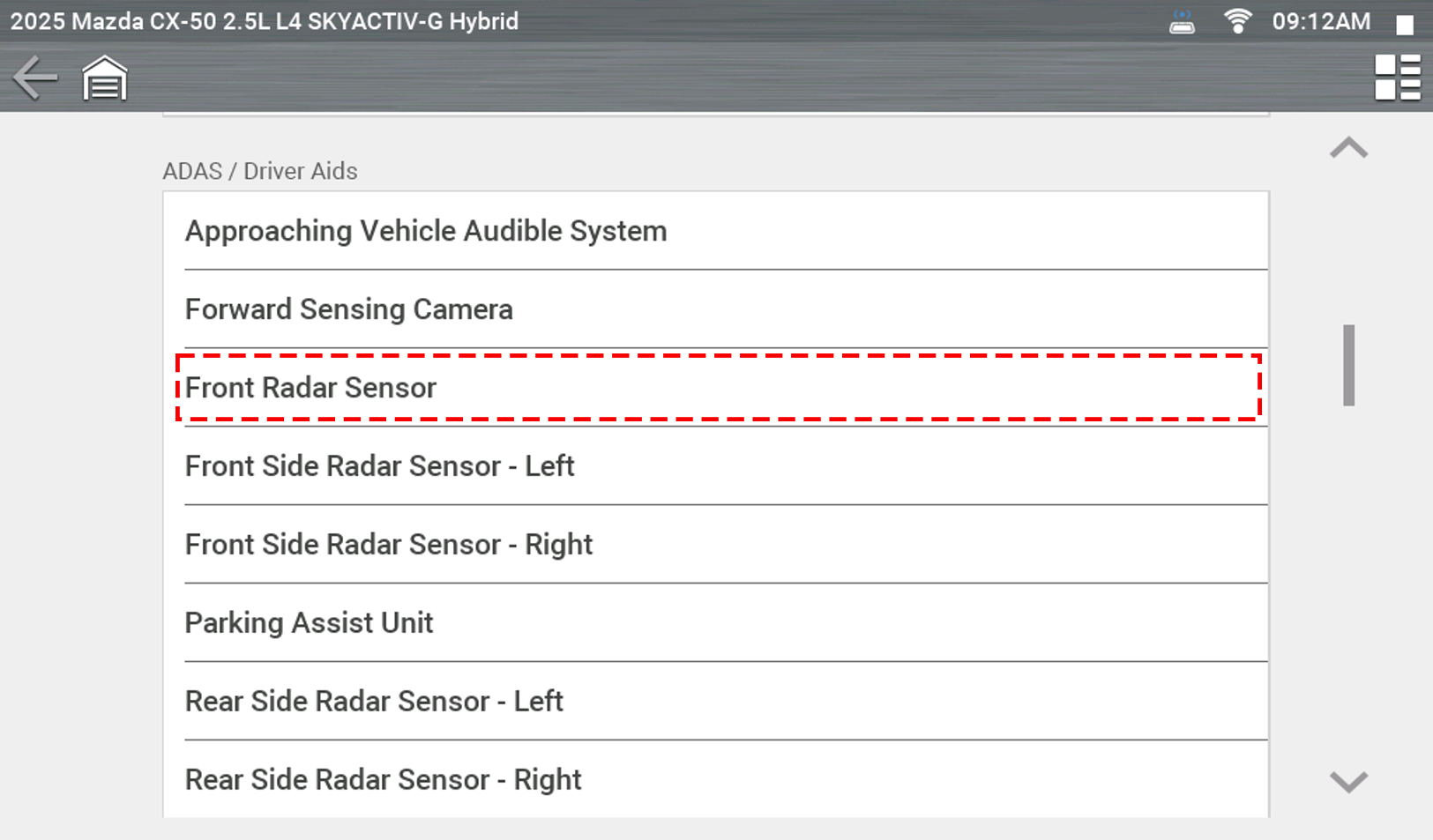
Mazda® Front Radar Dynamic Aiming is available on SOLUS+™, APOLLO™, TRITON™ and ZEUS+® Series platforms with current software. The function can be accessed through the ADAS / Driver Aids menu, where calibration procedures are grouped together for quick and consistent access. This makes it easy for technicians to locate and perform the required Dynamic Aiming procedure following repairs.
Because Dynamic Aiming does not require a physical target, it can be a practical solution for collision repair facilities and bodyshops looking to bring more ADAS recalibration procedures in-house. This functionality is included as part of the latest Snap-on Software plan, helping shops complete repairs efficiently while reducing reliance on third-party calibration providers.
The Front Radar Dynamic Aiming procedure should be completed under the following conditions:
- Vehicle speed must be 3 mph (5 km/h) or greater
- Deceleration must not exceed 2.5 m/s²
- The vehicle must be operated on a straight road with a turning radius of 100 m (328 ft) or greater
- The roadway should contain roadside structures such as guardrails, buildings or signs
Driving while maintaining these conditions does not need to be continuous. Refer to the applicable workshop manual for additional conditions that may prevent the Dynamic Aiming procedure from completing successfully.
Performing Mazda® CX-50 Front Radar Dynamic Aiming Recalibration

* Shown on a Snap-on® SOLUS+™
From the Systems Selection menu:
- Select Front Radar Sensor from the ADAS / Driver Aids menu.
- Select Special Functions.
- Select Front Radar Dynamic Aiming.
- Follow the on-screen instructions.
Note: The procedure may take up to 15 minutes to complete. Ensure the scan tool battery is sufficiently charged to prevent the tool from entering sleep mode during the procedure. For safety reasons, the driver must pay full attention to the road and traffic conditions and should not monitor the diagnostic tool screen while driving.
The screenshots shown in this example were captured on a Mazda® CX-50. The Front Radar Dynamic Aiming procedure is also applicable to Mazda® CX-90 vehicles.
Mazda Front Radar Dynamic Aiming is available on current SOLUS®, APOLLO™, TRITON™ and ZEUS® Series platforms as part of the latest Snap-on® software plan, which includes ADAS coverage at no additional cost. The function is also supported on other legacy Snap-on® diagnostic platforms with current software. View all supported platforms and software information here.
Recommended tool for this task:
USAGE
Everyday
EXPERIENCE LEVEL
Established
TECHNICIAN ROLE
General Repair Tech, Service Writer
ADDITIONAL FEATURES
Suggested Expert Information from Other Techs, Ability to Switch to Spanish Language, Advanced Graphing Features
I'm Interested
Complete the Repair with Confidence
As ADAS systems continue to evolve, calibration procedures are becoming an essential part of modern vehicle repair. The addition of Front RADAR Dynamic Aiming coverage for 2024+ Mazda CX-50 and CX-90 vehicles gives technicians the ability to complete an important post-repair procedure directly through their Snap-on diagnostic platform.
RADAR calibration is not simply another service function. It is the final step that helps ensure the vehicle's safety systems operate as intended and that the repair is truly complete. With Dynamic Aiming coverage now available, technicians can finish the job confidently, efficiently and in line with OEM requirements.
Related Dynamic Aiming Resources
FAQs
1) Which Snap-on Diagnostic Tools can platform perform a ADAS Recalibrations?
ADAS recalibration is available on: SOLUS®, APOLLO™, TRITON™ and ZEUS® Series platforms with current software, assisting technicians to complete the required recalibration procedures, following repairs for supported OEMs within our software. For more information click here.
2) Does Mazda Dynamic Aiming require a RADAR target?
No. The Dynamic Aiming procedure added for Mazda CX-50 and CX-90 vehicles does not require a physical RADAR target. But it's essential to use a Diagnostic Scan Tool with ADAS coverage to carry out the recalibration, like the SOLUS+.
3) When should Front RADAR Dynamic Aiming be performed?
It should be considered following repairs or replacement work that could affect RADAR alignment, including RADAR replacement and front-end collision repairs.
4) What DTC may indicate the RADAR aiming procedure has not been completed?
Mazda vehicles may set C1A67:54 – Front RADAR Sensor Aiming Adjustment Not Implemented if the required procedure has not been carried out using a Diagnostic Scan Tool with ADAS coverage like the latest Snap-on diagnostic tools.
5) Why is RADAR calibration important?
Proper RADAR calibration ensures systems such as Adaptive Cruise Control and other RADAR-dependent ADAS features operate accurately following repair work.
6) What is the main advantage of Dynamic Aiming?
Dynamic Aiming reduces workshop setup requirements by eliminating the need for traditional RADAR calibration targets while still allowing technicians to restore proper RADAR alignment.
7) Do you have to pay extra for ADAS diagnostic coverage?
No, not with a Snap-on scan tool on current software, unlike the competitors who charge additional fees for ADAS software coverage.
*This article is intended for informational purposes only and is designed to provide general technical insight. It is not intended to serve as step‑by‑step repair or diagnostic instruction. Always follow manufacturer approved procedures and safety guidelines when carrying out vehicle diagnostics or repairs.
Technicians should always consult the relevant vehicle manufacturer's service information when carrying out diagnosis, servicing or repairs. Mazda is a registered trademark of Mazda Motor Corporation. Any reference to vehicle manufacturers, models or trademarks is for identification and compatibility purposes only and does not imply any affiliation with or endorsement by Mazda.