This article is not a step‑by‑step repair guide or a substitute for certified high‑voltage training. Working on HEV vehicles requires formal HEV training, OEM‑approved procedures, and the correct PPE and tooling. Improper handling of high‑voltage systems can result in serious injury or death. Always follow OEM service information and local regulations. Snap‑on assumes no responsibility for injury, damage, or improper application of this information.
EV Systems: How They Are Engineered & How They Work
EV Battery – “basically a battery on wheels!”
Many EV systems are structural and part of the frame, so EVs often require specific lifts and battery lifting equipment. If the vehicle is purely EV, the electric motor and battery are placed first and the rest of the vehicle is built around them. If the platform also has gasoline/diesel variants, the EV system is designed to fit within an existing ICE layout — many components will resemble traditional ICE components. Battery size varies depending on the platform and construction.
EV Components Include:
There are no federal certifications required to work on EVs in the United States.
Although legal, this is not recommended without proper high-voltage training.
Technicians should obtain:
Battery Thermal Management
Cooling is essential for battery life and performance.
Cooling methods:
Components:
Liquid systems may also heat the battery in cold weather.
Inverter and DCDC Converter
Monitoring & Control
Battery control modules monitor:
Tech Tip: Check min/max block voltage and block delta. Large deltas often set P0BBD00 (battery pack voltage variation exceeded limit).
Battery Block
-
High voltage battery control module
-
High voltage cable
-
Cell (negative connection)
-
Cell (positive connection)
-
Battery bus bar
Battery control module sense wires:
a) Block 1
b) Block 2
c) Block 3
With your scan tool, you can view individual battery block voltages.
High Voltage Safety — Essential Practices Before Any Diagnostic Work
⚠️ High‑voltage systems remain energized for up to 10 minutes after shutdown.
Orange‑sheathed components indicate HV. Severe injury or death may occur with improper handling.
Important Notice: This section is for awareness and general guidance only — it is not instructional. Working on high‑voltage systems requires formal HEV training, OEM repair information, and approved safety equipment. Snap‑on does not assume responsibility for injury, damage, or incorrect application of the information presented.
Always follow OEM procedures and local regulations before performing any work on high‑voltage systems.
Minimum Practice Checklist
-
Deenergize and wait: follow OEM shutdown and discharge periods.energize &
-
PPE: tested class 0 gloves, arc‑rated clothing, face shield, and HV‑safe footwear.
-
Lockout/Tagout: secure disconnects and post signage.
-
Tools and meters: insulated tools; CAT III/IV ≥1,000 V multimeter.
Never pierce HV cables.
-
Training: HEV training is strongly advised.
Electric Motor, Resolver & Reduction Gear
Electric Motor
Charging & Regenerative Braking
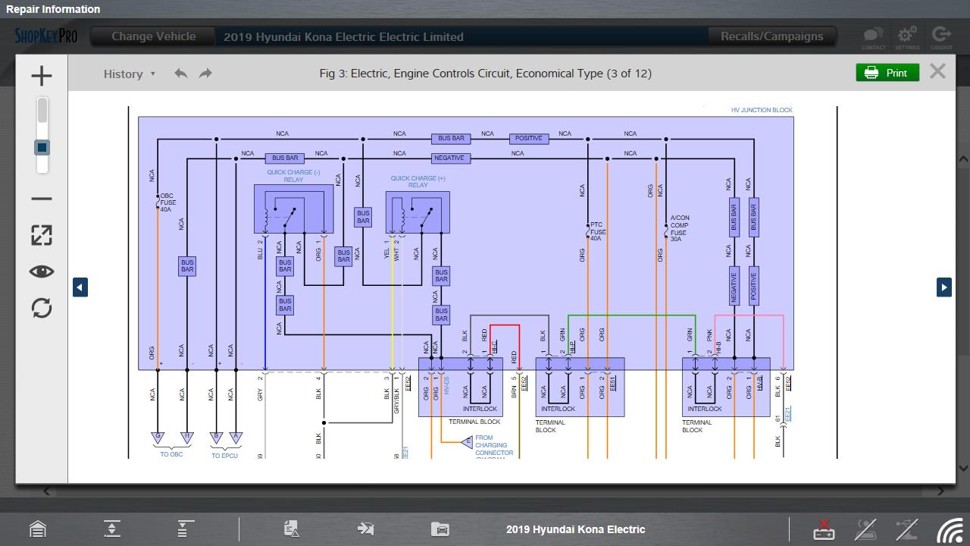
Charging circuit diagram through ShopKey Pro Repair Information – 2019 Hyundai Kona Electric
Regenerative Braking
Golden Rules:
-
Scan tool first — HEVs depend on coordinated communication between modules (BPCM, inverter, charger, ABS, HVAC, etc.), so issues are usually identified through scan‑tool data rather than direct circuit testing.
-
12 V battery health is critical.
-
Avoid using a lab scope on HV circuits unless you have rated probes and OEM procedures.
-
Visual inspection is essential: seals, connectors, coolant, heat damage.
Hybrid Systems Overview
Hybrid Battery
Hybrid Regenerative Braking
Parallel Hybrid (most common)
Series Hybrid (less common)
Plug-in Hybrid (PHEV)In Hybrid (PHEV)
Squashing a myth:
A common belief is that you can’t diagnose or repair much on an HEV because a scope can’t be used on high‑voltage circuits. That part is true — you should never scope HV circuits without the correct rated equipment and OEM approval.
But that doesn’t mean you can’t work on HEVs, or that you should avoid them.
Modern HEVs are built around software, control modules, and networked electronics, just like ICE vehicles.
This means most real‑world diagnosis happens through your scan tool, not on the high‑voltage circuits themselves.
Many HEV faults are:
Beyond the high‑voltage system, HEVs still rely on all the everyday vehicle systems you diagnose regularly, including:
-
Body control functions (doors, windows, lighting, immobilizer, keyless entry)
All of these require a scan tool — exactly as they do on gasoline and diesel vehicles.
Your Snap‑on diagnostic platform gives you access to:
-
TPMS, HVAC, body‑system functions, thermal‑management data, and more
You can diagnose far more on an HEV than many technicians think — and avoiding them only means falling behind.
HEVs are already in your bay. Stay prepared, stay trained, and keep your platform updated to stay in the game.
Exclusive New Functionality in your Snap‑on Diagnostic Tool
RAM ProMaster 2024–2025 — Battery Pack Control Module (BPCM)
New content has now been added for the RAM ProMaster 2024–2025 Battery Pack Control Module (BPCM).
New Supported Procedures:
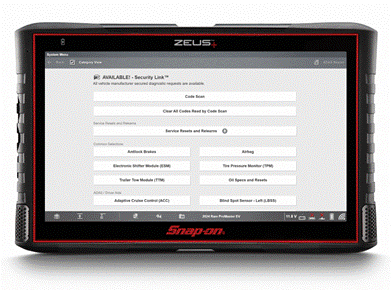
Enable HV (High Voltage) Battery Contactors
HVB Cell Voltage Difference Fault Reset
Resets the HVB (high-voltage battery) cell voltage difference fault in the BPCM and is required to clear:
HVB Impact Event Reset
Required to clear:
HVB Isolation Fault Reset
Resets isolation-related faults in the BPCM and is required to clear:
Tip: At the end of this procedure, BPCM DTCs are automatically cleared and reread.
If P0AA6-00 or P0AA8-00 are still active, refer to service information for diagnostic steps.read.00 or P0AA8AA are still active, refer to service information for diagnostic steps.
Important: Repair the following active DTCs before performing this reset:
Isolation Test
Initiates the isolation test for the entire vehicle’s HV system:
After the test completes, the tool will display the measured isolation impedance.
Stuck Contactor Fault Resets
Complete these if any of the following DTCs are present:
Note: To ensure the reset is successful, the BPCM DTCs will be automatically cleared and reread at the end of this procedure. If any of the stuck contactor fault DTCs remain, refer to service and repair information for further diagnostics.
7. OEM-Specific - TeslaSpecific — Tesla
Model S and X (up to 2020): Standard OBDII Port
These vehicles include a standard OBDII port, allowing a Snap-on diagnostic tool to connect directly and access a wide array of functions similar to a conventional ICE vehicle.
Accessible Systems
Battery‑related Tests
Other Supported Tests
Key takeaway:
Model S/X up to 2020 are like regular OBD-equipped vehicles for diagnostics which is a huge advantage for independent shops and a significant opportunity with the added capability of your scan tool brings to service and repair these vehicles.
Model 3 / Model Y and Newer S/X
-
Full OEM info available via ShopKey Repair Information, (requires a ShopKey subscription, speak to your Snap-on Representative for more information) additionally, repair information is available directly from OEM via Tesla Service
Your Scan Tool Is the Key to HEV Success
HEV systems may seem unfamiliar, but much of the diagnostic work is software‑based and fully accessible through your scan tool. With proper safety practices, OEM procedures, and updated coverage, including RAM ProMaster BPCM functionality, technicians can diagnose and repair far more than expected.
HEVs are already rolling past your shop. Stay prepared, keep your scan tool updated, and stay in the game.
FAQ’s
1. Can you diagnose an electric vehicle without working on the high-voltage system?
Yes. Many HEV faults are software‑driven and module‑managed, meaning diagnosis is carried out using a scan tool, not by probing high‑voltage circuits. HEVs still contain all the familiar vehicle systems you diagnose daily — body controls, ADAS, HVAC, ABS/ESC, infotainment, TPMS, and more, all fully accessible through your scan tool.
2. Do I need special certification to work on HEVs in the United States?
No federal certification is legally required to work on HEVs in the U.S. However, formal high‑voltage safety training is strongly recommended before working on or near HV components. Always follow OEM safety procedures, service information, and local regulations.
3. Can a scan tool reset or repair high-voltage battery faults?
Yes. Many HEV battery‑related issues can be resolved using guided scan‑tool functions, such as:
These functions are essential after repairs to HEV battery systems, such as those supported on the RAM ProMaster (2024–2025) BPCM.
4. What HEV components require a scan tool to diagnose or reset?
A scan tool is required for diagnosing:
Because HEVs rely heavily on software‑orchestrated systems, accurate diagnosis depends on scan‑tool data, resets, and functional tests.
5. Can HEVs be diagnosed in the same way as ICE vehicles?
Yes — with differences. While HEVs add high‑voltage and electric‑drive components, they still use many of the same systems as ICE vehicles. The majority of faults in HEVs are identified through module communication, live data, and scan‑tool‑guided routines. High‑voltage areas, however, require specialised training and OEM procedures.