Adaptive Cruise Control (ACC) is an Advanced Driver Assistance System (ADAS) designed to enhance driver convenience. ACC uses radar technology to monitor traffic ahead, helping maintain a selected following distance while automatically adjusting vehicle speed when required.
Unlike conventional cruise control systems, ACC can respond to changing traffic conditions without driver intervention, using a combination of radar inputs, braking systems and engine controls to operate effectively.
On supported BMW vehicles, restoring Active Cruise Control following repair may require a Radar Sensor Start-Up procedure, helping ensure the front radar sensor continues to provide accurate information to the wider ACC system.
Understanding Active Cruise Control Systems
A vehicle fitted with Adaptive Cruise Control uses radar technology to monitor the vehicle's position in traffic. As vehicles and obstacles are detected ahead, the system continuously calculates distance and relative speed.
If traffic slows, ACC can reduce vehicle speed automatically to help maintain a selected following distance. Vehicle speed is managed through the electronic throttle control system and, when necessary, the vehicle's braking system.
The driver remains responsible for controlling the vehicle. Driver inputs may override or affect ACC operation; always refer to the applicable vehicle manufacturer's instructions.
1) Time gap between ACC vehicle and other traffic.
While many technicians think of ACC as a radar system, it is actually a network of systems working together.
- Radar/ACC control Module
- Brake electronic control module
- Instrument panel
- Engine control module
- Steering wheel with cruise control switch
- Wheel speed sensor wiring
- CAN bus wiring
The radar provides information, but it is the communication between these systems that allows ACC to monitor traffic, adjust speed and respond to changing road conditions.
More Than Just a Radar Sensor
The front ACC sensor is often viewed as the heart of the system, but it is only one part of a much larger process. Radar information is shared across multiple control modules via the CAN network, allowing the engine management system, braking system and instrument cluster to work together. The ACC system coordinates these functions to maintain the selected following distance and respond to changing traffic conditions. For this reason, restoring Active Cruise Control following repair is not simply about replacing a sensor. It is about ensuring the entire system can once again communicate and operate as designed.
BMW's Approach to ACC Calibration
BMW's Radar Sensor Start-Up procedure does more than simply initiate calibration. Before the procedure can begin, vehicle systems may need to meet specific operating conditions to ensure the Active Cruise Control system can be restored correctly. Depending on vehicle configuration, technicians may be required to confirm that the radar sensor is unobstructed, suspension systems are operating correctly and related vehicle systems are free from faults before proceeding.
This reflects the wider role the ACC sensor plays within the vehicle. The system relies not only on accurate radar information, but also on communication between braking, engine and vehicle dynamics systems to support safe operation.
Why Radar Accuracy Matters for BMW Active Cruise Control
The ACC system is only as effective as the information being supplied to it. If the radar sensor is not correctly aligned, the system may not interpret surrounding traffic as intended. Even though the sensor itself may still be functioning correctly, its position relative to the vehicle may have changed during repair.
Modern BMW vehicles often utilise multiple radar sensors throughout the vehicle. While rear sensors may support features such as Blind Spot Monitoring and Cross Traffic Alert, the forward-facing ACC sensor is responsible for providing the information required by Active Cruise Control.
This is particularly important because the front radar sensor is mounted within one of the most commonly repaired areas of the vehicle.
Repairs involving:
- Front-end collision damage
- Front bumper replacement
- ACC sensor replacement
- Radar mounting repairs
- Bodyshop repair work within the radar zone
Any of these can create the need for recalibration. In many cases, the radar sensor may still be operating correctly, but the system requires verification and recalibration following repair.
Calibration Does Not Mean Component Failure
One of the most common misconceptions surrounding ADAS repairs is that calibration is only necessary when a component fails. In reality, many radar calibration procedures are performed because repair work may have altered the sensor's position relative to the vehicle.
The ACC sensor may be functioning perfectly. However, if its mounting position, angle or reference point has changed, calibration may be required before the Active Cruise Control system can operate as intended. This makes calibration a repair procedure rather than a fault repair. Understanding that distinction helps technicians avoid unnecessary component replacement while ensuring the repair is completed correctly.
When Is Calibration Required?
Calibration requirements should always be considered whenever repairs have the potential to affect radar positioning.
Common examples include:
- ACC sensor replacement
- Front bumper replacement
- Front-end collision repairs
- Radar bracket repairs or replacement
- Structural repairs affecting the radar mounting area
For many bodyshops and repair facilities, these situations have become increasingly common as radar-equipped vehicles continue to grow in number.
Performing the BMW Radar Sensor Start-Up Procedure
The following example was performed on a BMW X1 (U11). Subject to the specific vehicle, configuration and software version, the Radar Sensor Start-Up procedure may also be supported on:
- BMW 2 Series Active Tourer (U06)
- BMW X2 (U12)
- BMW 7 Series (G70)
- BMW iX (I20)
BMW Radar Sensor Start-Up can be accessed through the ADAS menu, where calibration procedures are grouped together for quick and consistent access. This makes it easy for technicians to locate and perform the required ACC calibration procedure following repair.
Vehicle Preparation
Before performing the Radar Sensor Start-Up procedure:
This is a general overview only. Procedures and prerequisites vary by vehicle and software version. Trained technicians must follow the on-tool instructions and current vehicle-manufacturer service information.
Perform a pre-scan and confirm there are no stored faults relating to:
These checks help ensure the Active Cruise Control system is ready for calibration and reduce the risk of the procedure failing to complete successfully.
From the Systems Selection menu:
1. Select Active Cruise Control (ACC).
2. Select Functional Tests.
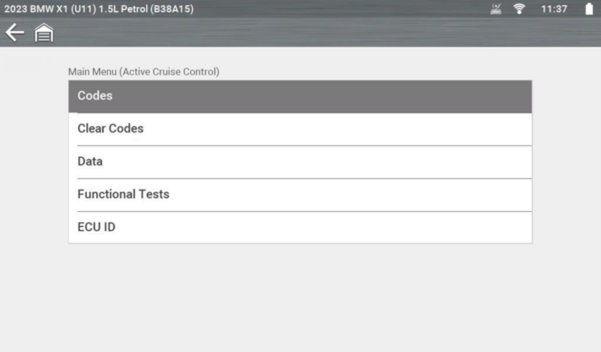
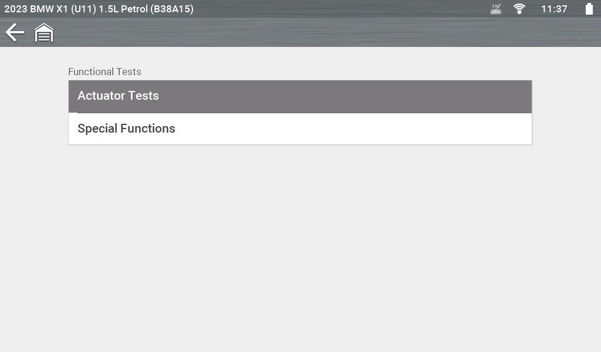
3. Select Special Functions.
4. Select ACC Start-Up.
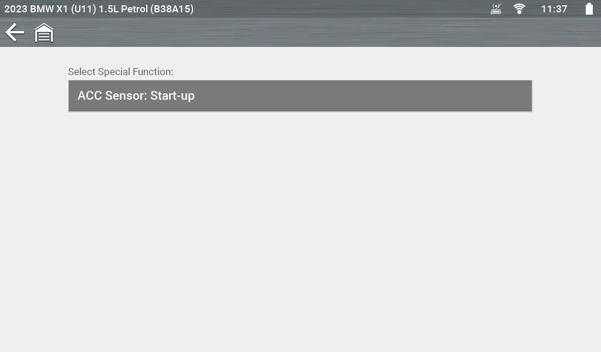
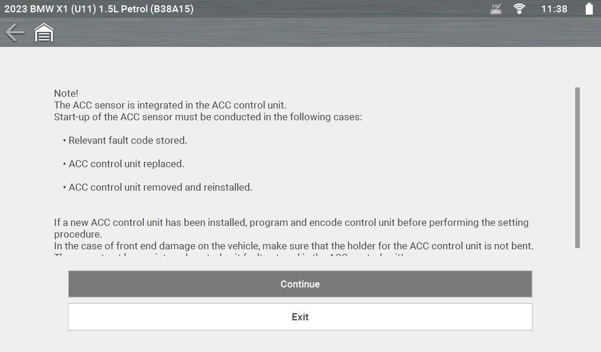
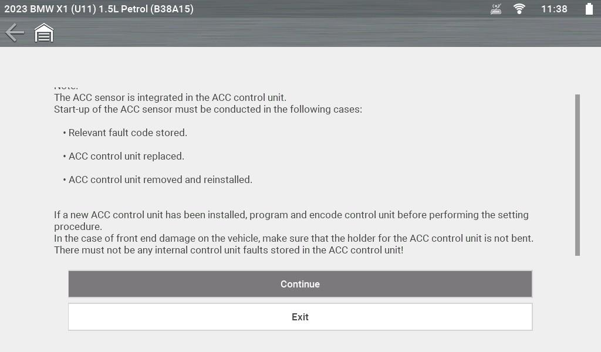
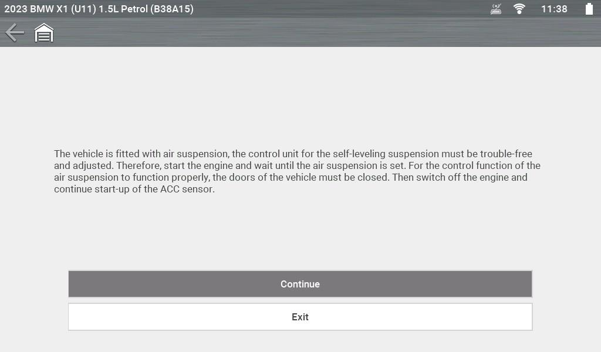
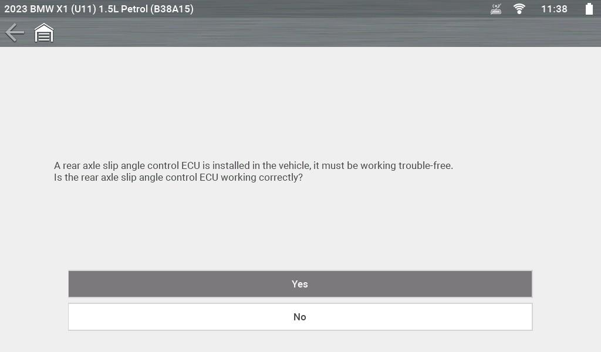
5. The tool will remind the technician that the front registration plate and surrounding bracket must be removed before proceeding with calibration.
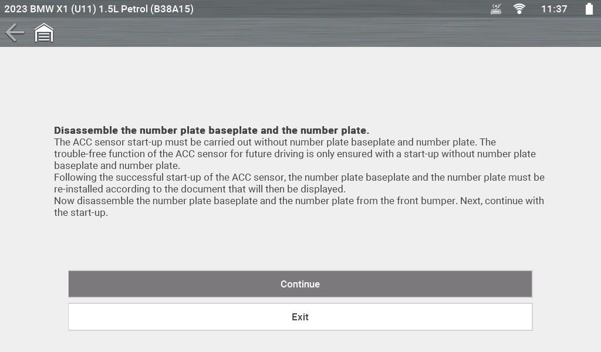
6. Follow the on-screen instructions.
Completing the Procedure
Once the Radar Sensor Start-Up procedure has completed successfully:
- Save the ADAS calibration report.
- Where required by the applicable OEM procedure, and once the registration plate and bracket have been refitted, road test the vehicle in safe and lawful conditions using a suitably trained technician, and verify Active Cruise Control operation
- Perform a post-scan.
- Confirm there are no remaining ACC-related DTCs.
Completing these final verification steps helps ensure the Active Cruise Control system has been restored correctly and that the vehicle is ready to be returned to the customer.
Recommended Workflow
To maximise repair quality and verify successful completion:
- Perform a pre-scan and document vehicle faults.
- Complete all required repairs.
- Verify radar installation and mounting integrity.
- Perform the Radar Sensor Start-Up procedure.
- Follow all applicable OEM requirements.
- Confirm successful completion of the procedure.
- Perform a post-scan and verify system operation.
As part of a complete repair workflow, technicians should perform a pre-scan before repairs and a post-scan following calibration. Snap-on® diagnostic platforms provide access to Complete Code Scan and Diagnostic Health Scan functionality to help document repairs and share reports through the Snap-on® Cloud. Where applicable, wheel alignment should also be verified before ACC calibration.
Where supported for the specific vehicle and configuration, technicians using the ZEUS®, TRITON™ APOLLO™ and SOLUS™ Series platforms, tools running the current software, can access the BMW Radar Sensor Start-Up function to support Active Cruise Control (ACC) calibration, front radar service procedures and post-repair system verification.
Recommended tool for this task:
USAGE
3–5 Times a Week
EXPERIENCE LEVEL
Advanced
TECHNICIAN ROLE
Diagnostic Specialist, Garage Manager
ADDITIONAL FEATURES
Access to Technical Service Bulletins (TSBs), Lab Scope Abilities, Step-by-Step Guided Tests, Suggested Expert Information from Other Techs, Advanced Graphing Features, Filtered Data, In-Tool Learning
I'm Interested
Complete BMW Active Cruise Control Repairs with Radar Calibration
Adaptive Cruise Control is an advanced driver assistance systems found on modern BMW vehicles. While the ACC sensor is a vital component, the system's ability to monitor traffic and manage vehicle speed depends on multiple vehicle systems working together.
Following repair, replacing damaged components is only part of the process. Proper radar calibration helps ensure the complete Active Cruise Control system is restored and able to operate as intended. With the addition of the Radar Sensor Start-Up special function on supported Snap-on® diagnostic platforms, technicians can perform an important post-repair procedure that supports BMW Active Cruise Control restoration and helps return vehicles to service with confidence.
Snap-on® Exclusive: Learn More About ADAS Systems
Looking to build your understanding of ADAS, vehicle communications and modern driver assistance technologies?
Guided Component Tests Classes are available on supported Snap-on® diagnostic platforms with current software. This feature transforms your diagnostic platform into an on-demand learning hub that can be accessed anytime, at your own pace.
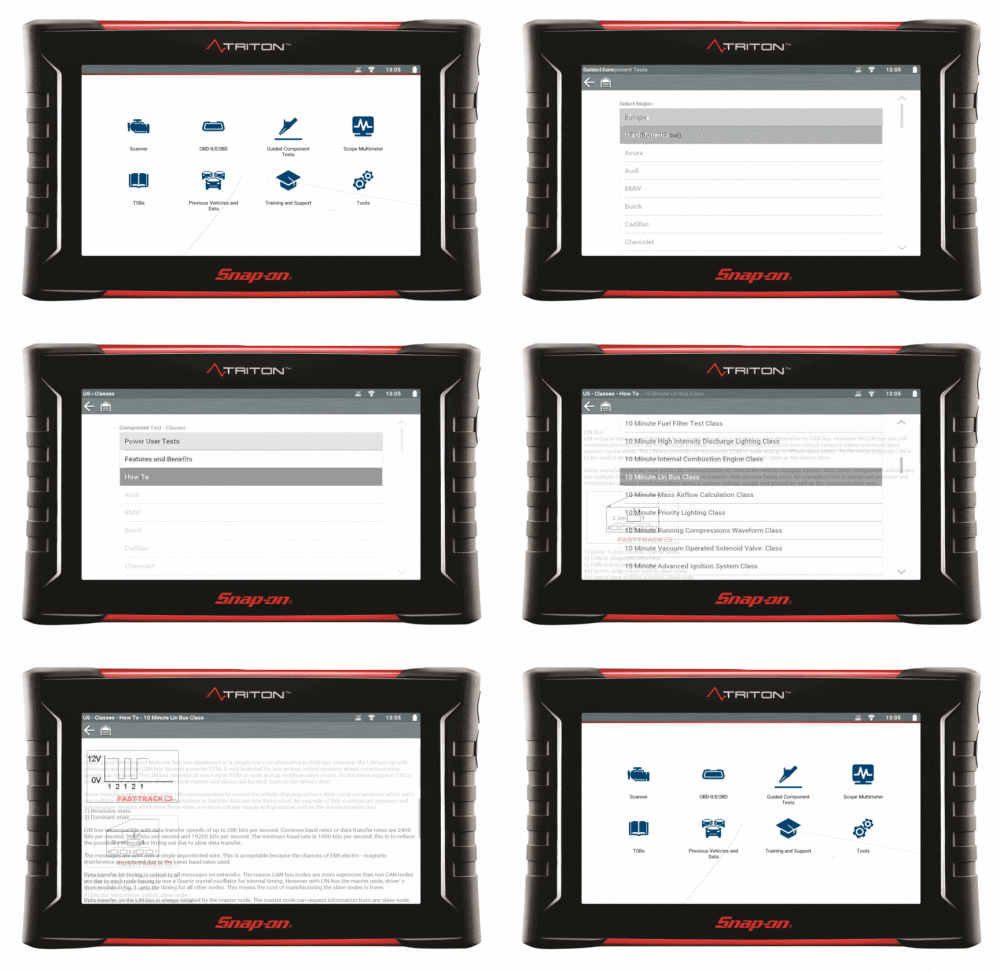
Accessing Classes
From the home screen, select: Guided Component Tests → Classes → How To
Technicians can access a growing library of practical, real-world training content, including:
...and many more.
Whether you're diagnosing vehicle communication faults, learning the fundamentals of ADAS systems or expanding your understanding of Active Cruise Control, Guided Component Tests Classes provide convenient training directly from your diagnostic platform.
FAQ’s
1) Which Snap-on Diagnostic platform can perform ADAS Recalibrations?
ADAS recalibration is available on supported Snap-on® diagnostic platforms running current software for supported vehicles and configurations, assisting technicians to complete the required recalibration procedures, following repairs for supported. For more information click here.
2) What is BMW Active Cruise Control (ACC)?
BMW Active Cruise Control (ACC) uses a forward-facing radar sensor to monitor traffic ahead and help maintain a selected following distance. The system can automatically adjust vehicle speed using throttle and braking inputs when traffic conditions change.
3) How does BMW Active Cruise Control work?
The ACC sensor continuously monitors the distance and relative speed of vehicles ahead. This information is shared with vehicle systems such as the engine control module and brake control module, allowing the vehicle to automatically adjust speed and maintain a selected following distance.
4) What is the BMW Radar Sensor Start-Up procedure?
Radar Sensor Start-Up is a post-repair procedure used to help restore Active Cruise Control operation following repairs that affect the front radar sensor or its mounting position. The procedure helps ensure the ACC system can receive accurate information from the radar sensor.
5) When should the BMW Radar Sensor Start-Up procedure be performed?
The procedure should be considered whenever repairs or replacement work may affect the front radar sensor, including:
- Front-end collision repairs
- Front bumper replacement
- ACC sensor replacement
- Radar mounting bracket repairs
6) Does BMW Radar Sensor Start-Up mean the radar sensor is faulty?
No. In many cases, the radar sensor may be functioning correctly. The procedure is often required because the sensor's position relative to the vehicle may have changed during repair work.
7) Why is radar calibration important for BMW Active Cruise Control?
BMW Active Cruise Control relies on accurate radar information to calculate vehicle distance and relative speed. If the radar sensor is not correctly calibrated, the ACC system may not operate as intended.
8) Which BMW models are supported by the Radar Sensor Start-Up function?
Subject to the specific vehicle, configuration and software version, supported BMW Models may include:
- BMW 2 Series Active Tourer (U06)
- BMW X1 (U11)
- BMW X2 (U12)
- BMW 7 Series (G70)
- BMW iX (I20)
9) Which Snap-on® diagnostic platforms support BMW Radar Sensor Start-Up?
Where supported for the specific vehicle and configuration, technicians using Snap-on® ZEUS®, TRITON™ and APOLLO™ Series platforms, as well as MODIS Edge™ and VERUS® Edge tools running current software, can access the BMW Radar Sensor Start-Up special function. This function supports BMW Active Cruise Control (ACC) calibration following radar replacement, collision repair and other repairs affecting radar alignment.
*This article is intended for informational purposes only and is designed to provide general technical insight. It is not intended to serve as step-by-step repair or diagnostic instruction. Always follow manufacturer-approved procedures and safety guidelines when carrying out vehicle diagnostics or repairs. Technicians should always consult the relevant vehicle manufacturer's service information when carrying out diagnosis, servicing or repairs. BMW is a registered trademark of Bayerische Motoren Werke AG. Any reference to vehicle manufacturers, models or trademarks is for identification and compatibility purposes only and does not imply any affiliation with or endorsement by BMW.